Technical Skills in Soccer: Complete Guide for 2025 Training
Technical skills in soccer form the foundation of every successful player’s development. These fundamental abilities include ball control, passing, shooting, dribbling, and first touch – skills that separate good players from great ones. Whether you’re a beginner learning the basics or an advanced player refining your technique, mastering these technical skills is essential for soccer excellence in 2025.
What Are Technical Skills in Soccer
Technical skills in soccer are the physical abilities required to control, manipulate, and direct the ball effectively during gameplay. These skills form the building blocks of all soccer tactics and strategies. Unlike tactical or physical attributes, technical skills focus purely on a player’s relationship with the ball and their ability to execute specific movements with precision and consistency.
The core technical skills include ball control, passing accuracy, shooting technique, dribbling ability, and first touch quality. Professional soccer academies across the United States emphasize that players must develop these skills before advancing to complex tactical systems. Technical proficiency directly impacts a player’s confidence, decision-making speed, and overall effectiveness on the field.
The 5 Essential Technical Skills Every Soccer Player Needs
Understanding the fundamental technical skills in soccer helps players prioritize their training efforts effectively. These five core skills represent the minimum technical foundation required for competitive soccer at any level.
Ball Control and First Touch
Ball control encompasses a player’s ability to receive, cushion, and direct the ball in various situations. The first touch determines whether a player maintains possession under pressure or loses the ball to opponents. Elite players demonstrate exceptional first touch technique that immediately puts them in advantageous positions to make their next move.
Passing Accuracy and Technique
Passing technique involves using different parts of the foot to deliver the ball accurately to teammates. Short passes require inside-foot precision, while long passes demand proper weight distribution and follow-through. Modern soccer emphasizes passing accuracy rates above 85% for professional players, making this skill crucial for maintaining team possession and creating scoring opportunities.
Dribbling and Close Ball Control
Dribbling skills allow players to navigate through tight spaces while maintaining ball possession. Effective dribbling combines close ball control, body feints, and change of pace to deceive defenders. Players must develop both feet equally to become unpredictable dribblers capable of creating space in congested areas of the field.
Shooting Power and Precision
Shooting technique requires proper body positioning, foot placement, and follow-through to generate both power and accuracy. Professional players practice various shooting scenarios including volleys, half-volleys, and ground shots from different angles. Technical shooting skills determine a player’s ability to convert scoring chances into goals consistently.
Heading Technique and Timing
Heading technique involves using the forehead to direct the ball accurately while maintaining proper body positioning and timing. Players must coordinate their jump, neck muscles, and eye contact with the ball to execute effective headers. Technical heading skills are essential for both defensive clearances and offensive scoring opportunities from set pieces.
Technical Skills for Soccer Beginners
Beginning players should focus on fundamental technical skills that build confidence and establish proper movement patterns. Starting with basic techniques prevents the development of bad habits that become difficult to correct later in a player’s development.
Foundation Juggling Drills
Juggling practice develops touch sensitivity, coordination, and ball familiarity essential for all soccer skills. Beginners should start with two-foot juggling before progressing to alternating feet, thighs, and headers. Regular juggling sessions of 10-15 minutes daily significantly improve a player’s technical foundation and ball comfort level.
Basic Cone Dribbling Exercises
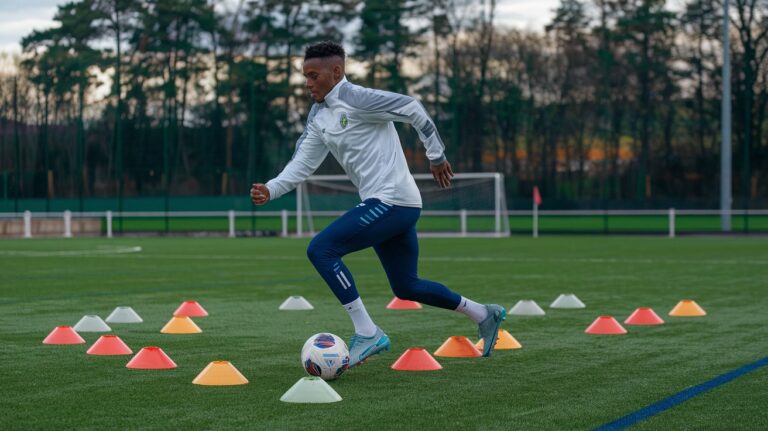
Cone dribbling teaches players to maintain ball control while navigating obstacles at various speeds. Simple cone patterns help beginners develop both feet equally while practicing different touches and body movements. These technical drills improve agility, balance, and spatial awareness crucial for game situations.
Progressive Technical Soccer Drills
Advanced technical soccer drills challenge players to perform skills under increasing pressure and complexity. These progressive exercises simulate game conditions while focusing on specific technical improvements.
Shadow Playing Technique
Shadow playing involves performing technical skills without a ball while visualizing game scenarios. This mental and physical practice improves movement patterns, body positioning, and muscle memory. Players practice technical movements at game speed while focusing on proper form and coordination without ball distraction.
Pressure Finishing Drills
Pressure finishing drills replicate match conditions where players must execute shooting techniques under time constraints and defensive pressure. These exercises develop technical composure and improve decision-making speed in the final third. Players practice various shooting angles while maintaining proper technique despite external pressure.
Technical vs Tactical Skills in Soccer
Technical skills focus on individual ball mastery and physical execution, while tactical skills involve decision-making, positioning, and team coordination. Understanding this distinction helps players allocate training time appropriately between individual skill development and team strategy work.
Technical proficiency must precede tactical complexity because players cannot execute team strategies without reliable individual skills. US Soccer Development Academy emphasizes that young players should achieve technical competency before introducing advanced tactical concepts. The ideal training ratio dedicates 60% of time to technical skill development for players under 14 years old.
Individual Technical Soccer Training Methods
Self-directed technical training allows players to focus on specific weaknesses and develop skills at their own pace. Individual practice sessions should emphasize quality repetitions over quantity to ensure proper technique development.
Effective individual technical drills include wall passing for first touch, cone weaving for dribbling, and target shooting for accuracy. Players should dedicate 30-45 minutes daily to individual technical skill practice during the off-season to maintain and improve their abilities. Video analysis helps players identify technical deficiencies and track improvement progress over time.
Related video about technical skills in soccer
This video complements the article information with a practical visual demonstration.
Key Questions and Answers
What are the 4 basic soccer skills every player needs?
The four basic soccer skills are ball control (first touch), passing accuracy, dribbling ability, and shooting technique. These fundamental skills form the foundation for all soccer play and must be developed before advancing to complex tactical systems.
How do technical skills differ from tactical skills in soccer?
Technical skills involve individual ball mastery and physical execution like dribbling, passing, and shooting. Tactical skills focus on decision-making, positioning, and team coordination. Technical skills must be developed first as they enable tactical execution.
What are examples of technical skills in soccer training?
Technical skill examples include juggling for touch development, cone dribbling for ball control, wall passing for first touch improvement, target shooting for accuracy, and shadow playing for movement patterns. These drills focus purely on individual ball manipulation.
How often should soccer players practice technical skills?
Soccer players should practice technical skills daily for 30-45 minutes, with focused sessions 4-5 times per week. Young players under 14 should dedicate 60% of training time to technical skill development before emphasizing tactical concepts.
Can technical skills in soccer be self-taught?
Yes, many technical skills can be self-taught through individual practice with proper guidance and video analysis. Wall passing, juggling, cone dribbling, and shooting practice can all be performed alone with consistent effort and attention to proper technique.
What is the most important technical skill in soccer?
Ball control and first touch are considered the most important technical skills because they determine possession retention and enable all other skills. Without proper first touch, players cannot effectively pass, dribble, or shoot in game situations.
| Technical Skill | Training Focus | Key Benefit |
|---|---|---|
| Ball Control | First touch and juggling practice | Possession retention under pressure |
| Passing Accuracy | Target practice and wall passing | Team possession and chance creation |
| Dribbling | Cone weaving and close control | Space creation and defender elimination |
| Shooting | Power and precision training | Goal conversion efficiency |