15 Best Soccer Dribbling Moves That Beat Defenders in 2025
Soccer dribbling moves are the foundation of elite ball control that separates good players from great ones. Whether you’re a beginner learning your first soccer dribbling moves or an advanced player perfecting complex techniques, mastering these skills gives you the edge to beat defenders consistently. This comprehensive guide covers 15 essential moves that every serious player should know, complete with step-by-step instructions and pro tips.
Essential Soccer Dribbling Moves for Beginners
Starting with soccer dribbling moves for beginners builds the foundation for advanced techniques later. These fundamental moves focus on simple body positioning, basic ball control, and developing confidence with the ball at your feet. According to US Youth Soccer, over 3 million young players benefit from mastering these basic moves before progressing to complex skills.
The key to successful dribbling skills lies in consistent practice and understanding the mechanics behind each move. Beginners should focus on executing these moves at walking speed first, gradually increasing tempo as muscle memory develops. Professional coaches recommend practicing these moves 15-20 minutes daily for noticeable improvement within 4-6 weeks.
The Cut – Your First Essential Move
The Cut represents the most fundamental of all soccer moves and serves as the building block for advanced techniques. This move involves using the inside of your foot to redirect the ball at a sharp angle while your body moves in the opposite direction. Practice this move by approaching the ball at moderate speed, planting your non-kicking foot firmly, and using the inside of your foot to push the ball perpendicular to your original direction.
Simple Step-Over Technique
The step-over creates hesitation in defenders through deceptive body movement combined with ball control. Start by running toward the ball, step your right foot over the ball without touching it, then immediately push the ball away with the outside of your left foot. This soccer dribbling move works best when you sell the fake direction convincingly with your shoulders and eyes looking where you pretend to go.
Classic Soccer Dribbling Moves That Never Fail
Time-tested soccer dribbling moves have remained effective for decades because they exploit fundamental weaknesses in defensive positioning. These classic techniques form the backbone of professional play and continue dominating at the highest levels of the game. Major League Soccer players still rely heavily on these proven methods during crucial match situations.
The beauty of classic moves lies in their simplicity and effectiveness across all competitive levels. From youth leagues to professional soccer, these moves consistently create scoring opportunities when executed properly. Understanding the timing and situational application of each classic technique separates recreational players from serious competitors.
The Cruyff Turn Mastery
Named after Dutch legend Johan Cruyff, this dribbling move involves appearing to pass or shoot before cutting the ball behind your standing leg with the inside of your foot. The defender commits to blocking your intended direction while you escape in the opposite direction. Practice this by approaching at full speed, planting your left foot next to the ball, then using your right foot to drag the ball behind your left leg.
The Matthews Cut Excellence
The Matthews Cut combines a body feint with precise ball manipulation to create space against tight-marking defenders. This soccer move requires dropping your shoulder in one direction while simultaneously pushing the ball in the opposite direction with the outside of your foot. Professional players use this technique most effectively when approaching defenders at moderate speed with adequate space to execute the cut.
Advanced Soccer Dribbling Moves for Elite Players
Advanced soccer dribbling moves require exceptional ball control, perfect timing, and complete mastery of fundamental techniques. These sophisticated moves demand hundreds of hours of dedicated practice and should only be attempted after mastering basic skills. Elite players in MLS and international competitions use these techniques to create magic moments that change game outcomes.
The complexity of advanced moves means they carry higher risk but offer greater rewards when executed successfully. These soccer dribbling moves often involve multiple touches, complex body positioning, and split-second decision-making that separates professional players from amateurs. Success rates improve dramatically when players understand the specific game situations where each advanced technique proves most effective.
The Elastico Perfection
The Elastico, popularized by Ronaldinho, involves pushing the ball outward with the outside of your foot before immediately snapping it back inward with the inside of the same foot. This dribbling move creates a rubber band effect that leaves defenders frozen as the ball changes direction twice in quick succession. Master this by practicing the two-touch combination slowly, focusing on the smooth transition between outside and inside foot contact.
The Hocus Pocus Magic
The Hocus Pocus combines elements of the Elastico with additional flair, involving a behind-the-leg touch followed by an immediate direction change. This advanced soccer move requires exceptional flexibility and ball control, making it one of the most challenging techniques to master. Professional players reserve this move for specific situations where style points matter as much as beating the defender.
Types of Soccer Dribbling and Their Applications
Understanding the different types of dribbling helps players choose the most effective technique for specific game situations. Speed dribbling focuses on maintaining possession while moving quickly upfield, while close control dribbling emphasizes keeping the ball near your feet in tight spaces. Technical dribbling involves complex moves designed to beat defenders through skill rather than pace.
Each type of dribbling serves distinct tactical purposes within team strategy. Speed dribbling works best during counterattacks and transition plays, close control proves essential in congested midfield areas, and technical dribbling creates opportunities in the final third. Professional coaches teach players to recognize situations and select appropriate dribbling styles accordingly.
Best Soccer Dribbling Moves for Different Positions
Position-specific best soccer dribbling moves maximize effectiveness based on where players operate on the field. Wingers benefit from moves that create space along the touchline, while central midfielders need techniques that work in congested areas. Forwards require moves that create shooting opportunities in tight spaces near the goal.
Tactical awareness determines which soccer dribbling moves prove most valuable for each position. Defenders use simple but effective moves to escape pressure and maintain possession, while attacking players employ flashier techniques to create scoring chances. Understanding positional requirements helps players focus practice time on moves that directly improve their game performance.
Winger-Specific Techniques
Wingers excel with moves that create space along the sideline and set up crossing opportunities. The Rivelino move works perfectly for beating fullbacks by using the outside of the foot to push the ball wide before cutting inside. Practice this by approaching the touchline at pace, showing the defender you’re going outside, then quickly cutting the ball inside with the inside of your foot.
Central Player Moves
Central midfielders need dribbling moves that work in tight spaces with limited room for error. The Roulette (Zidane turn) proves perfect for escaping pressure by spinning 360 degrees while maintaining ball control. Execute this by stepping over the ball with your right foot, then using the sole of your left foot to drag the ball back while spinning your body in the same direction.
5 Steps to Perfect Soccer Ball Dribbling
Mastering soccer ball dribbling follows a systematic five-step progression that builds skills methodically. Step one involves developing basic ball familiarity through juggling and simple touches. Step two focuses on stationary moves without defensive pressure, allowing players to perfect technique before adding complexity.
Steps three through five introduce progressive challenges including moving execution, defensive pressure, and game-speed application. This structured approach ensures players develop proper technique before attempting advanced moves under pressure. Professional academies worldwide use this methodology to develop technical excellence in young players.
Foundation Building (Steps 1-2)
The first two steps focus on building comfort with the ball through repetitive technical work. Step one involves 10-15 minutes daily of basic ball touches using different parts of your foot. Step two introduces stationary execution of fundamental moves like the step-over and cut, emphasizing proper body positioning and ball placement without time pressure.
Advanced Application (Steps 3-5)
Steps three through five transition players from technical execution to practical application. Step three involves practicing moves while jogging, step four adds cone courses that simulate defensive pressure, and step five requires executing moves during small-sided games. This progression ensures technical skills translate effectively into match situations.
Showboating Soccer Moves and When to Use Them
Spectacular moves like the Rabona and Rainbow flick serve specific purposes beyond pure entertainment value. The Rabona involves kicking the ball with your dominant foot wrapped around your standing leg, creating unexpected angles that surprise defenders. While flashy, these moves work best when they serve tactical purposes rather than mere showmanship.
Professional players understand that showboating moves must contribute to team success rather than individual glory. The Nutmeg proves highly effective for beating defenders while maintaining forward momentum, making it both spectacular and practical. Timing and situational awareness determine when flashy techniques enhance rather than hinder team performance.
Training Drills for Soccer Dribbling Improvement
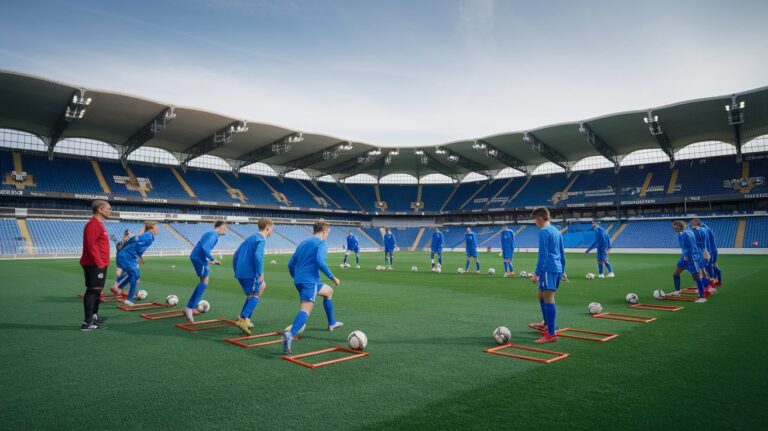
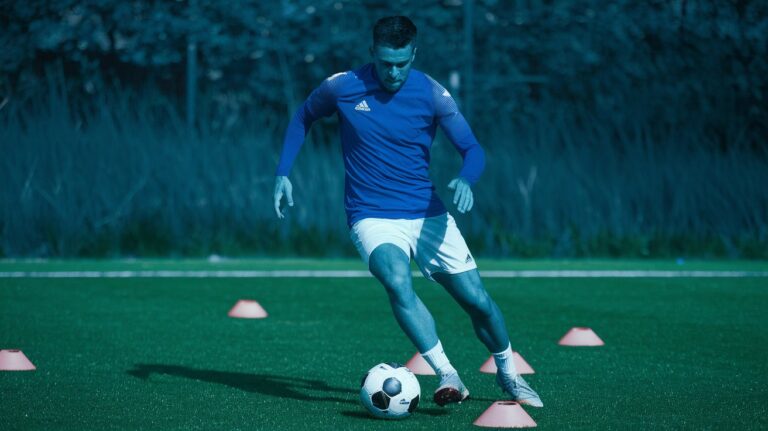
Effective training drills accelerate dribbling skill development through focused repetition and progressive challenge. Cone weaving drills develop close ball control while maintaining pace, mirror drills improve reaction time and adaptability, and 1v1 scenarios test moves under realistic defensive pressure. US Soccer recommends dedicating 30% of individual training time to dribbling skill development.
Structured training programs produce measurable improvement in soccer dribbling moves when practiced consistently. Professional development programs emphasize quality over quantity, focusing on perfect execution of fewer moves rather than sloppy attempts at numerous techniques. Video analysis of training sessions helps identify technical flaws and track improvement over time.
Common Mistakes in Soccer Dribbling Execution
Telegraphing moves represents the most common error in dribbling technique, where players signal their intentions through obvious body language before executing. Successful moves require selling the fake convincingly while maintaining balance and ball control. Professional players practice neutral body positioning that conceals their true intentions until the last moment.
Overdribbling often undermines team play as players attempt complex moves in inappropriate situations. Smart players recognize when simple ball retention serves the team better than elaborate techniques. Understanding game context and defensive positioning helps players choose appropriate responses rather than forcing unnecessary skills.
Related video about soccer dribbling moves
This video complements the article information with a practical visual demonstration.
Frequently Asked Questions
What are the different types of dribbling in soccer?
The three main types of dribbling in soccer are speed dribbling (maintaining possession while moving quickly), close control dribbling (keeping the ball near your feet in tight spaces), and technical dribbling (using complex moves to beat defenders). Each type serves specific tactical purposes and requires different skill sets to master effectively.
What are the moves in soccer called?
Soccer moves are called by various names including step-overs, cuts, turns, flicks, and nutmegs. Many moves are named after famous players who popularized them, such as the Cruyff Turn, Elastico (Ronaldinho), Matthews Cut, and Zidane Roulette. These names help players and coaches communicate specific techniques during training and matches.
What are 5 steps to dribbling a soccer ball?
The 5 steps to dribbling a soccer ball are: 1) Develop basic ball familiarity through daily touches, 2) Practice stationary moves without pressure, 3) Execute moves while jogging to add movement, 4) Practice with cones simulating defensive pressure, and 5) Apply moves in small-sided games under real match conditions. This progression builds skills systematically.
What is the best dribble technique in soccer?
The best dribble technique depends on the situation, but the simple cut using the inside of your foot remains most effective across all levels. This fundamental move works in tight spaces, creates immediate direction changes, and forms the foundation for advanced techniques. Professional players rely on this basic technique more than flashy moves during crucial match moments.
How long does it take to master soccer dribbling moves?
Basic soccer dribbling moves can be learned in 4-6 weeks with consistent daily practice, while advanced techniques may take 6-12 months to master. Professional players spend years perfecting their skills, with most reaching peak technical ability after 3-5 years of dedicated training. Progress depends on natural ability, practice frequency, and quality of coaching received.
Which soccer dribbling moves work best for beginners?
Beginners should start with the cut, simple step-over, and basic body feints before attempting advanced moves. These fundamental techniques build confidence, develop ball control, and establish proper body positioning. The fake pass and stop-and-go moves also work well for beginners because they require minimal technical skill while remaining highly effective against defenders at youth levels.
| Skill Level | Recommended Moves | Practice Time |
|---|---|---|
| Beginner | Cut, Step-over, Body feint | 15-20 min daily |
| Intermediate | Cruyff Turn, Matthews Cut, Roulette | 25-30 min daily |
| Advanced | Elastico, Hocus Pocus, Rabona | 35-45 min daily |
| Professional | All moves with situational mastery | 60+ min daily |